



In many Nigerian workplaces, there is an employee who rarely draws attention to himself.
He is not the most vocal in team meetings. He does not circulate updates about his accomplishments on LinkedIn or make a point of ensuring leadership is aware of his daily contributions. He arrives, completes his work to a consistent standard, and leaves. When he does speak, his input is considered and deliberate — not because he lacks perspective, but because he does not measure his value by how often he is heard.
Over time, his colleagues form a quiet consensus about him. He is seen as reliable but unremarkable, someone who is present without being particularly notable. His manager holds a similar impression. At performance review time, that impression translates into a score that is fair by the standards of the system: steady, competent, nothing that suggests he warrants closer attention or accelerated development.
Then he submits his resignation.
What follows is the kind of revelation that tends to silence an office. He has not been drifting. He has been building, methodically and without announcement, developing his skills, pursuing opportunities, and positioning himself for something considerably beyond what anyone around him had assumed he was capable of. He leaves for a role that surpasses what most of his colleagues are currently working towards, and the organisation is left to reckon with what it missed.
This is not an isolated incident. It is a pattern that repeats itself in growing businesses across Nigeria and the wider African market, and it points to a question that most performance management systems are fundamentally not equipped to answer: if your most capable people are the ones who do not market themselves, does your current system have any reliable way of seeing them?
What Is Performance Appraisal Bias and Why Does It Affect Growing Teams?
Performance appraisal bias occurs when a manager's ratings are shaped by factors other than actual work performance. The most damaging type in growing businesses is presence bias, the tendency to rate employees higher based on how visible they are rather than what they have actually delivered.
Presence bias is a well-documented pattern in performance evaluation, managers unknowingly rate employees higher based on their visibility rather than their actual contributions and results. It is not malicious. It is what happens when a system has no structured way to capture what people are actually doing, so it defaults to capturing who people are seen to be doing.
The people who speak up in meetings, who are in the manager's line of sight, who bring visible energy into the office, they get noticed. Their appraisals reflect that noticing. And the quiet, consistent contributors get averaged out. Not because their work is average, but because nobody built a system to see it.
The Nigerian Journal of Management Sciences (2023) documented exactly this pattern in growing Nigerian organisations, appraisals routinely shaped by memory, gut feel, and the impressions formed by whoever was most present in the manager's field of vision. Not documented evidence. Not structured criteria. Impressions.
Why Do Performance Reviews Feel Unfair in Nigerian SMEs?
In most growing businesses across Lagos, Abuja, and Accra, performance reviews feel unfair because the process was never designed to be objective. There are no criteria defined before the cycle begins. There is no ongoing documentation of contributions throughout the year. There is no structured channel for employees to communicate what they have done or how they are experiencing their work.
What exists instead is one conversation at the end of the year, built on whatever the manager happened to notice, which, in a busy, fast-moving team, is usually the people who made the most noise.
Research from South-West Nigeria found that the perception of an unfair appraisal process directly increases employee turnover intention, with many employees leaving organisations specifically because they believed the performance appraisal process was unfair or that the rater had not evaluated them ethically.
The quiet employee in the story did not wait to find out if his review was fair. He made his move before the system got the chance to misread him. And in doing so, he took with him everything he knew, everything he had built, and everything he would have contributed, quietly, consistently, for years more.

What Is the Real Cost of Unrecognised Performance?
When strong employees go unrecognised, the cost is rarely visible immediately. It accumulates slowly, through disengagement, reduced output, and eventually resignation. By the time the damage is obvious, it has already been compounding for months.
85% of employees would consider leaving after receiving what they perceive as an unfair performance assessment. The employees most likely to act on that feeling are not the low performers. They are the high performers, the ones who know exactly what they delivered, who have options elsewhere, and who are least willing to tolerate a system that cannot see them accurately.
Research tracking nearly 3,500 employees found that well-recognised employees are 45% less likely to have turned over after two years. Recognition is not a soft benefit. It is one of the most reliable retention levers available, and it only works when the system is built to surface who is actually performing, not just who is most visible.
For a 30-person SME in Lagos, losing one strong performer to a competitor or an international opportunity is not just an inconvenience. It is a loss of institutional knowledge, client relationships, and operational continuity that takes months and significant resources to recover from.
How Can Growing Businesses Recognise Employees Who Do Not Market Themselves?
The answer is not to ask quiet employees to become more vocal. Professional presence matters, and developing it is a legitimate career skill. But the responsibility does not sit entirely with the employee.
Organisations that recognise all of their contributors, not just the visible ones, share something in common. They have built systems that do not depend on self-promotion to surface good work.
That means defining performance criteria before the cycle begins, so ratings are anchored to evidence rather than impression. It means capturing contributions as they happen throughout the year, not reconstructing them from memory at review time. It means giving every employee, regardless of personality type, a structured, consistent channel to document what they have done and how they are experiencing their work. Organisations that build employee presence systematically, through regular forums, structured recognition, and documented feedback, create environments where quiet contributors do not have to choose between performing and being seen.
When those systems are in place, the quiet employee does not have to become a different person to be evaluated fairly. Their work is visible because the system captured it, not because they chose to perform it for an audience.

What a Structured Performance Management System Looks Like
A performance system worth having should be able to answer one question at any point in the year: what has this person actually done, and how are they doing?
Not based on who they are socially. Not based on how many times they appeared in a meeting or how many LinkedIn posts they published. Based on documented evidence, milestones tracked, check-ins completed, contributions recorded, feedback exchanged throughout the year on both sides.
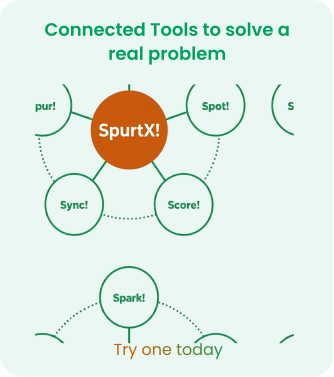
That is what Spur! is built for. Structured appraisal cycles, continuous employee surveys, and real-time performance dashboards that make the quiet employee in your office just as visible as the one who posts every win on LinkedIn, because visibility is built into how the system works, not dependent on how loudly someone chooses to show up.
The guy who resigned quietly? He was probably your best employee. And the next one just like him is still sitting in your office right now, delivering consistently, saying nothing, and deciding whether to stay.