



Ask most managers that question and they will give you an answer. Ask them to back it up with evidence, and things get complicated.
This is not a knock on managers. It is a structural problem. In most growing businesses, especially SMEs across Nigeria and the wider African market; performance tracking happens in people's heads. Ratings come from impressions, not documentation. Reviews are shaped by whoever had the most visible quarter, whoever spoke up in the last meeting, or whoever happened to avoid a mistake in the weeks before appraisal season.
The result is a system that feels like it is working right up until it isn't.
The Memory Problem in Performance Appraisals
There is a well-documented pattern in performance appraisals called recency bias, the tendency to judge an employee based on recent events rather than their full performance record. Work done in the last few weeks or months overshadows consistent results delivered earlier in the year, leading to skewed ratings, unfair rewards, and overlooked achievements.
It plays out in ways that will feel familiar. An employee who delivered solidly across the year hits a rough patch in the final quarter and gets a rating that reflects those last few weeks; not the ten months before them. Another employee who struggled all year turns it around just before review time and walks away with an above-average score. Recency bias is not the only problem either. The halo effect, proximity bias, and leniency tendency all quietly distort ratings in teams that have no structured criteria to anchor them.
According to SHRM, recency and central tendency errors affect nearly 40% of annual appraisals, almost half of all reviews distorted by memory lapses or conflict avoidance.
This is not a new finding. And it is not unique to any one country or industry. But it lands differently when you are a 30-person team where one unfair rating can quietly unravel months of motivation.

Visibility Is Not the Same as Performance
There is a second problem sitting underneath the memory problem, and it is more uncomfortable to name.
In most teams without a structured performance system, the people who get recognised are not necessarily the people who perform best. They are the people who are most visible, the ones who are in the room when decisions get made, who are comfortable speaking up, who have a good relationship with their manager.
Quiet, consistent contributors often get overlooked. Not because their work is not valuable, but because nobody built a system to see it.
This is why performance reviews feel unfair in so many small businesses. It is rarely about a manager's intentions. It is about the absence of a process. No pre-defined criteria. No ongoing documentation. No regular feedback loop. Just one conversation at the end of the year, built on whatever the manager can recall; which is rarely the full picture.
Research from African SMEs confirms that when employees perceive the appraisal process as unfair or inaccurate, it directly reduces their engagement and increases their likelihood of leaving. The damage is not always loud. People do not always resign immediately. They disengage slowly, deliver less, and eventually leave for somewhere they believe will see them more clearly. 85% of employees would consider quitting after receiving what they perceive as an unfair performance assessment. For a 30-person team, that is not a statistic. That is a real risk attached to every review cycle.
The Tool Problem Some teams try to solve this with spreadsheets. Others use a shared document updated once a year. A few rely on WhatsApp threads and email chains to capture performance notes. None of these were designed for this job, and it shows. It is worth being clear about what the difference between performance tracking and performance appraisal actually is. Performance tracking is the ongoing process of documenting how an employee is doing throughout the year; capturing milestones, noting achievements, flagging challenges as they happen. Performance appraisal is the formal evaluation at the end of a cycle where a manager assigns ratings and provides structured feedback. The two should work together. Tracking provides the evidence that makes appraisals fair and accurate. Without it, appraisals default to memory and impression, which introduces exactly the kinds of bias described above. 45% of managers do not think their formal performance review process brings value to the company. That figure is striking because most of those managers are not being cynical; they are being honest. When the system is built on memory, informal impressions, and annual check-ins, it is genuinely hard to see how it is helping anyone. The problem is not effort. Most managers care about their teams and want to give fair reviews. The problem is infrastructure. What Structured Performance Tracking Actually Looks Like Improving performance appraisals in a growing business does not require a complex overhaul. It requires a system that does a few things consistently:
Performance criteria are defined before the cycle begins; not invented during the review conversation
Evidence is captured as work happens, not scrambled together afterwards
Regular check-ins mean feedback is not saved for one high-stakes annual meeting
Employees have a structured, consistent channel to share how they are experiencing work; not just waiting to be evaluated.
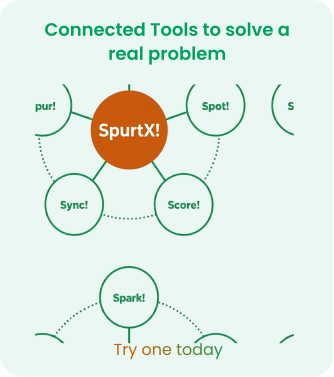
Most SMEs in Nigeria and across African markets are currently managing performance through informal channels; WhatsApp conversations, spreadsheets, occasional one-on-ones. The move to a dedicated system does not have to be complicated. What matters is that the process is defined, repeatable, and visible to both managers and employees. When those things are in place, the appraisal conversation becomes a review of documented reality rather than a negotiation about competing impressions. Managers make better decisions. Employees trust the process. And the people who have been delivering quietly all year finally get seen. That is what Spur! is built for, structured appraisal cycles, continuous employee surveys, and real-time performance dashboards; so the question of who is actually performing on your team has a clear, evidence-based answer. See how Spur! works