



Let's envision this scenario. A programme manager sits down on a Monday morning to review a cohort of learners who have just completed a digital skills programme. On paper, everything looks promising: attendance was strong, completion rates are high, and certificates have been issued. From a reporting standpoint, the programme has delivered.
But once the programme ends and these learners step into real work environments, a different reality begins to surface. Tasks take longer than expected, basic execution requires guidance, and confidence drops when structure is removed. The issue here is not effort, intelligence, or even access to learning. It is the gap between learning and application.
Across sub-Saharan Africa, this gap is becoming more visible as more graduates enter the workforce with credentials that do not consistently translate into capability. The structure that produced these outcomes was built for an earlier economy where knowledge retention defined readiness, while today’s workplace rewards application, adaptability, and measurable contribution. The World Economic Forum projects that 44% of core skills will change by 2027, with increasing emphasis on analytical thinking and applied problem-solving. This shift continues to expose the limitations of systems that do not consistently support practical execution.
The Illusion of Readiness
If you speak with most programme leads, educators, or hiring managers, you will hear a familiar pattern. They can often identify top-performing learners based on participation during sessions or performance in assessments. They know who asked the right questions, who submitted assignments on time, and who appeared engaged throughout the programme.
What they do not have is a clear, structured view of how each learner performs when faced with real, unstructured tasks. Instead, they rely on fragments such as assignment scores, attendance records, and occasional feedback. What is missing is a continuous, system-level view of capability.
This creates an illusion of readiness. Learners appear prepared within the structure of the programme, but once that structure is removed, performance becomes inconsistent.
The Structural Breakdown
The gap between learning and execution shows up in consistent ways across programmes. Learners are introduced to tools without sustained use, which creates familiarity without real competence. Facilitators operate without full visibility into how learners perform during actual tasks, so progress remains partially hidden. Participation is easier to track than contribution, meaning activity is recorded while output is harder to assess. Outcomes are often defined broadly, so completion replaces demonstrated ability, and curriculum evolves more slowly than market demand, leaving learners with skills that do not fully match real-world expectations.
These are not isolated issues. They are structural patterns that shape how learning is delivered and experienced.
Why Technology Alone Doesn’t Change the Outcome
Over the past decade, digital platforms have been introduced to improve learning delivery and access, yet outcomes remain uneven because technology reflects the system it operates within. When learning is designed around passive consumption, platforms extend that behaviour. When outcomes are loosely defined, data reflects that same ambiguity. When execution is not embedded into the process, tools increase exposure without strengthening capability.
This explains why many learning platforms gain early traction but later struggle to maintain relevance within programmes. UNESCO-UNEVOC highlights that digital learning is most effective when it is project-based and tied to real industry application, reinforcing the importance of structure over access alone.

The Cost of Delayed Execution
The consequences of this gap extend beyond individual learners. Workforce readiness develops more slowly even as demand for skilled talent increases, and many organisations struggle to find people who can contribute immediately. The World Economic Forum continues to highlight talent shortages across industries, reinforcing the disconnect between training and execution.
At the same time, opportunity becomes uneven. Learners who gain access to applied, structured environments progress faster, while others remain limited by systems that do not support execution. For organisations, this creates operational strain, as programmes run and cohorts graduate but measurable outcomes remain difficult to track consistently. Without visibility into execution, it becomes harder to intervene early or improve results over time.
What Changes When Execution Is Structured
When learning systems are designed around execution, the experience shifts in clear and measurable ways. Work becomes directly tied to real tasks, allowing learners to build capability through repeated application rather than exposure alone. Progress becomes visible throughout the process, making it easier to identify gaps early and provide timely support. Performance is measured in practical terms, so output becomes clearer than participation, and feedback happens during execution rather than after completion, allowing continuous improvement.
This is the principle behind structured programmes like S.T.E.P. (Spurt! Training and Entrepreneurship Programme), where foundational learning is combined with project-based work and supervised placements. The focus moves from what learners know to what they can consistently do.

Where SpurtX! Changes the Equation
Designing applied learning is one layer, but managing it at scale introduces a different challenge. Programme managers and organisations need to track learners beyond attendance, understand who is progressing and who needs support, coordinate facilitators and projects across multiple cohorts, and measure outcomes in a way that reflects real performance.
Without structured systems, this coordination becomes fragmented, relying on manual processes, disconnected tools, and delayed reporting.
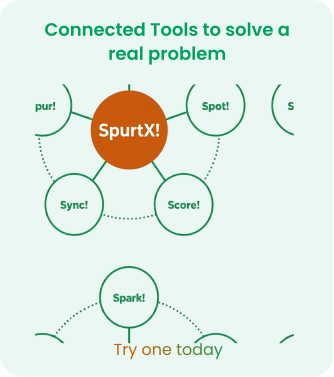
This is where SpurtX! becomes critical. SpurtX! provides the operational infrastructure that connects learning to execution within a single, structured system. Learner journeys can be tracked from onboarding through completion, engagement and performance become visible in real time, ownership across teams is clearly defined, and projects and milestones are coordinated within one environment. Outcomes are no longer assumed at the end of a programme but are measured as they develop.
This level of visibility changes how programmes operate. Instead of relying on periodic updates or end-of-cycle reports, programme teams can see what is happening as it happens and act early enough to influence outcomes.
From Reactive Delivery to Structured Execution
This shift fundamentally changes the role of programme managers and educators. With clear visibility into learner progress, they move from observing outcomes after the fact to shaping them during execution. Support becomes timely, feedback becomes targeted, and intervention becomes proactive.
Learning stops being a one-directional process and becomes a managed system of continuous development.
Conclusion
The challenge facing education and workforce development in Africa is not access alone. It is the ability to translate learning into consistent, measurable execution. As the demands of the workplace continue to evolve, the systems supporting learning must evolve alongside them, connecting learning directly to work, making progress visible, and ensuring that outcomes can be tracked and improved over time.
Africa’s talent base continues to grow, and the opportunity is clear. Strengthening the systems that guide how that talent is developed and applied determines how effectively it contributes to the economy. SpurtX! supports this shift by providing the structure required to move from learning to doing, and from participation to measurable capability. What Comes Next
The challenge is no longer awareness. It is execution. Most organisations already recognise the gap between learning and real-world capability. The next step is building systems that can consistently close that gap across cohorts, programmes, and regions.
If your work involves training, education, or workforce development, the question is no longer whether the gap exists. It is whether your current systems are structured enough to measure, manage, and improve outcomes in real time.
SpurtX! provides the operational infrastructure that connects learning to execution, helping teams move from fragmented coordination to structured, measurable delivery. If you want to see how this works in practice, you can request a demo here: https://spurtx.tools To go deeper into the structural issues shaping this gap and how applied learning models are evolving, you can also access the full report here: https://spurt.solutions/publications/recalibrating-education-for-the-realities-of-the-21st-century-marketplace