



Employee recognition is often seen as a cultural initiative, something that improves the morale of the employees, but sits outside the core operations of a business. For small and medium-sized enterprises (SMEs), this perception can be misleading.
Recognition is not just about making employees feel appreciated. It directly influences engagement, productivity, and retention. The consequences faced when recognition is absent or inconsistent can be more expensive than many leaders expect.
Recognition and Motivation
Employees rarely expect extravagant rewards for doing their jobs well, but they do expect that their meaningful contributions will be noticed. Recognition acts as a powerful signal that work matters. According to Workhuman, each moment of recognition contributes to a greater likelihood of high performance. This goes to show that when leaders acknowledge effort, they reinforce behaviours that support the organisation’s goals.
Employees begin to understand what success looks like and feel encouraged to continue contributing at a high level. Without recognition, that feedback loop disappears, and so employees may continue completing tasks, but the motivation to go beyond minimum expectations gradually fades.
The Rise of Quiet Disengagement
One of the most common outcomes of low recognition is disengagement. This disengagement rarely takes the form of open dissatisfaction at first. Instead, employees simply begin to invest less energy in their work. They do what is required but stop volunteering ideas, supporting colleagues, or taking initiative on projects. This pattern is often described as quiet disengagement. For SMEs that rely heavily on small, collaborative teams, even minor disengagement can affect overall productivity.

The Financial Impact
Low recognition not only affects culture, but it also carries measurable costs. Disengaged employees are more likely to look for opportunities elsewhere. When experienced team members leave, organisations face recruitment costs, onboarding time, and lost institutional knowledge. 74% of employees who feel unrecognised are more likely to say they do not plan to be at the organisation in one year
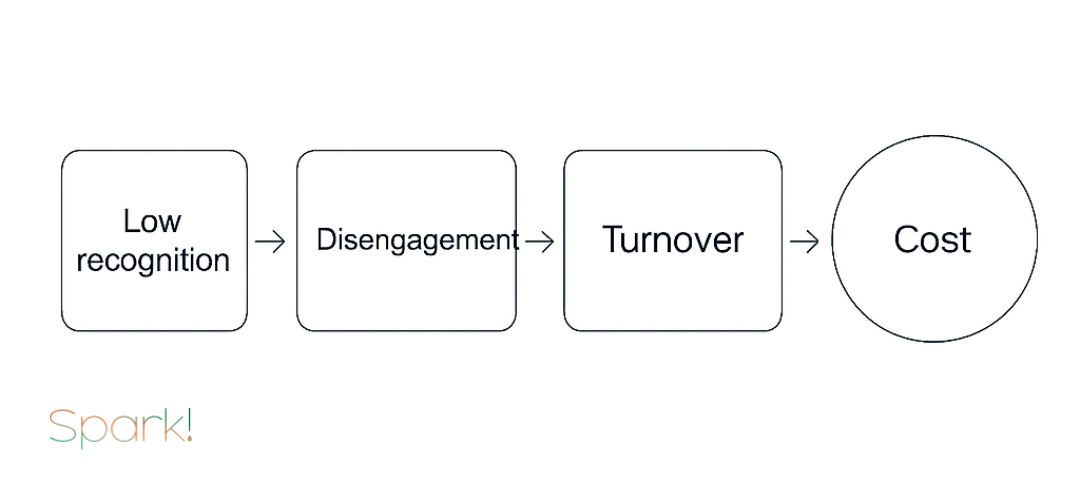
For SMEs operating with limited resources, replacing skilled employees can be particularly disruptive, as recruiting new talent often requires weeks or months of effort, and new hires need time to reach full productivity. These costs frequently exceed the investment required to build strong recognition practices in the first place.
Recognition Strengthens Retention
Employees who feel recognised tend to remain more committed to their organisations, because recognition, in its littlest form, reinforces a sense of belonging and contribution. And so, when employees believe their work has an impact, they are more likely to stay engaged with both their roles and the company’s broader mission. For SMEs competing with larger organisations for talent, this advantage is especially important. While larger companies may offer higher salaries or more extensive benefits, smaller organisations can build loyalty by creating environments where contributions are genuinely seen and valued.
Recognition as a Strategic Advantage
For SMEs seeking to grow and compete in increasingly complex markets, employee engagement is a critical asset, and recognition plays a central role in maintaining that engagement.
When organisations build cultures where effort is consistently acknowledged, they encourage behaviours that strengthen collaboration, innovation, and accountability. Over time, these behaviours become part of the organisation’s identity. Recognition, when treated a priority rather than a gesture, becomes a driver of both performance and retention.